.png)


Discover the meaning and impact of automotive lifestyle events

TL;DR:
Automotive lifestyle events focus on community, storytelling, and connection rather than competition or display. They foster ongoing relationships, shared norms, and authentic hospitality that sustain long-term engagement. These gatherings significantly impact local economies and social cohesion by emphasizing participation over rankings.
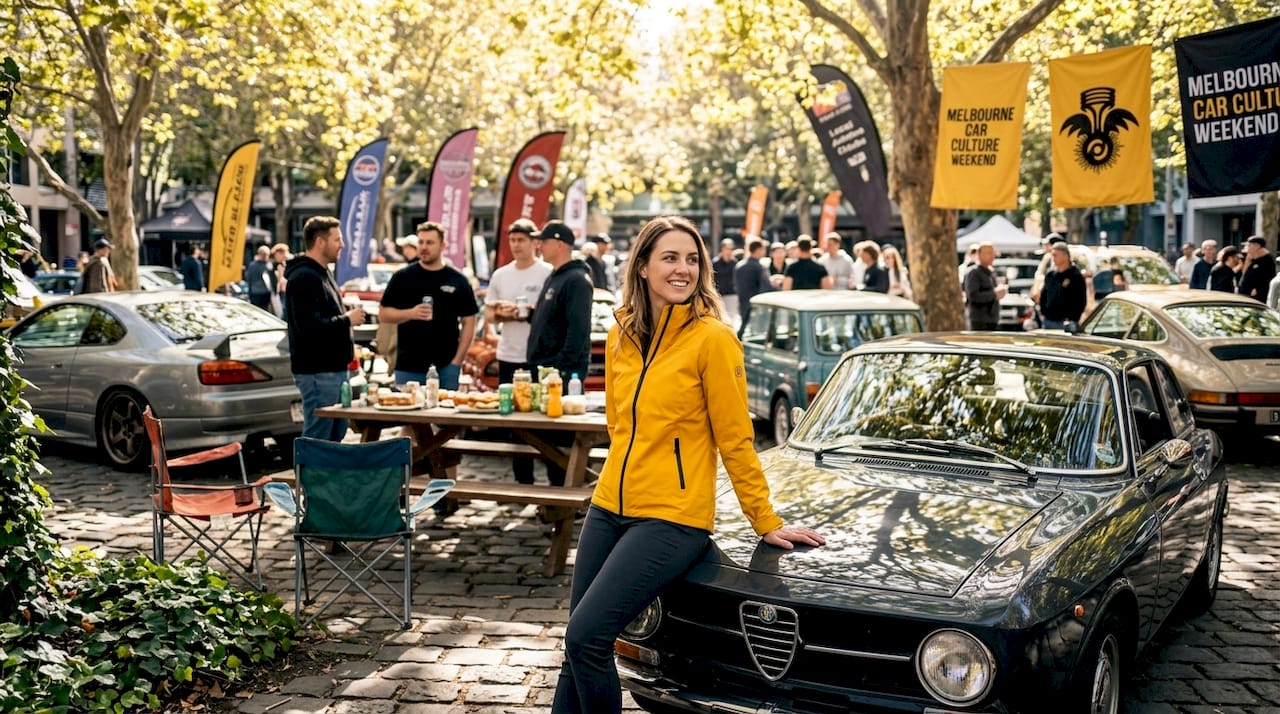
Walk into any car meet or cruise night and you will quickly realise that the engines are almost beside the point. The real draw is the crowd gathered around them. Automotive lifestyle events have grown into something far bigger than races, trophies, or vehicle displays. They shape identity, spark mentorships, inject revenue into local businesses, and create the kind of face-to-face connection that social media simply cannot replicate. This guide explains what these events truly are, what drives their cultural significance, and how you can spot or build a genuine one.
Table of Contents
Key Takeaways
Point | Details |
Beyond cars and trophies | Automotive lifestyle events focus on people, shared stories, and lasting community connections. |
Local economic benefits | Events often boost local businesses and create reasons for visitors to return. |
Storytelling and inclusion | Modern events centre on storytelling, mentorship, and open participation for all enthusiasts. |
Spotting authentic experiences | Genuine lifestyle events feature ongoing interaction, learning, and a welcoming format. |
Opportunity to get involved | Anyone can join or organise these gatherings to create real impact in their hobby and community. |
What are automotive lifestyle events?
Most people picture a racetrack or a show-floor when they hear the words “car event.” Lifestyle events sit in an entirely different category. They are built around the people, not just the machinery.
Automotive lifestyle events are fan, collector, and community gatherings that express identity and culture around cars, going far beyond the vehicles or racing results themselves. The emphasis is on shared values, personal storytelling, and the kind of authentic hospitality that keeps people coming back year after year. In motorsport contexts, broader descriptions frame the complete experience as a blend of culture, technology, and community, with live attendance as a core part of what makes it meaningful.
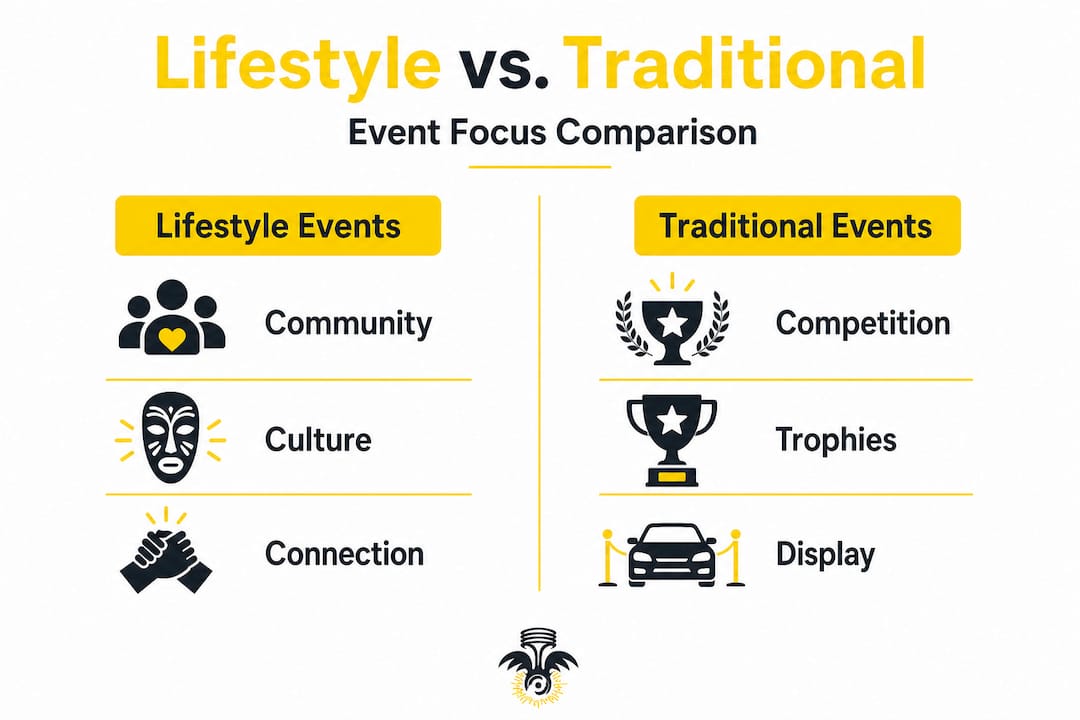
So what separates a lifestyle event from a traditional competition or static display? The best way to think about it is this: a traditional event asks “whose car is fastest or most impressive?” A lifestyle event asks “who are the people behind these cars, and what stories do they carry?”
The features that tend to define these gatherings include:
Open gathering spaces designed for lingering conversation, not just passing observation
Diverse vehicles and participants, from classic restorations to modern builds and everything in between
Story-sharing formats, including informal Q&A, marque histories, and owner spotlights
Hospitality elements such as food, music, curated routes, and family-friendly activities
Focus on experience over rankings, with little or no formal judging in many cases
Repeat attendance culture, where the same faces return season after season and relationships deepen
“It is not about the car alone. It is about the community that forms around it, the identity people build through their shared passion, and the culture that sustains both.”
If you want a broader picture of how these events fit within the wider world of car culture, exploring the types of automotive events will help you map the full landscape before you dive deeper.
Key features that define lifestyle events
Building from that definition, it helps to see the contrast clearly. Lifestyle events and traditional car events can occupy the same venues or attract similar vehicles, but their priorities are starkly different.
Feature | Lifestyle event | Traditional car event |
Primary focus | People, culture, and connection | Performance, display, or competition |
Judging | Minimal or absent | Central to the programme |
Interaction style | Open conversation, story-sharing | Spectating, formal presentation |
Community role | Builds ongoing relationships | Often one-off attendance |
Diversity of vehicles | Broad, inclusive | Often restricted by class or era |
Hospitality | High priority | Secondary concern |
Return rate | High, with loyal regulars | Variable |
These community-building formats extend interaction well beyond any main competition or display, using hospitality-style structures that encourage genuine mingling. Think of a paddock with long shared tables, a curated city cruise with a café stop built in, or a waterfront gathering where boat owners and jet ski riders talk freely about their builds.
The physical setting matters enormously. Lifestyle events tend to choose locations that invite participation: tree-lined main streets, waterfront promenades, heritage precincts, or open parklands. These spaces signal to attendees that the goal is to spend time together, not just move through a queue.
Core features that mark out an authentic lifestyle event include:
Repeated contact between the same participants across multiple events in a season
Shared norms around respect, curiosity, and welcoming newcomers
Open conversation facilitated by layout and format, not just encouraged by words
Mentorship pathways, where experienced enthusiasts naturally guide newer members
Pro Tip: When evaluating whether an event is genuinely community-focused, look at how the organiser promotes it. If the language centres on people, stories, and shared experiences rather than trophies and specifications, you are likely looking at an authentic lifestyle event. Language is a reliable signal.
If you are thinking about getting involved in planning these kinds of gatherings, the guide on organising automotive and water-sport events is a practical starting point.
Culture, community and the role of story
Now that you understand the features, it is worth looking at the deeper cultural machinery that makes lifestyle events so enduring. The most powerful ingredient is story.
The best automotive lifestyle events treat car culture as a living archive. Owners share the history of their builds, the mechanical lessons they learned through failure, and the people who mentored them. This approach shifts the format from traditional show or race events toward car culture as storytelling and legacy, a deliberate choice that opens doors to a far wider audience.
Why does authentic history matter more than trophies? Consider these reasons:
Trophies belong to one person. Stories belong to everyone who hears them.
History creates continuity. A community with shared memory feels stable and welcoming to newcomers.
Mentorship flows naturally from story-sharing, creating generational transfer of skill and passion.
Emotional investment increases when attendees see themselves reflected in the experiences being shared.
Diverse participation becomes possible when the measuring stick shifts from performance metrics to human interest.
“We are trying to create space for everyone who loves this culture, not just those who have the fastest car or the most pristine restoration. The story is the thing.”
This philosophy stands in direct contrast to the competitive spectacle model, where exclusivity and rankings define value. Some organisers intentionally reduce exclusivity and reframe what counts, moving away from gatekeeping and toward a more expansive definition of who belongs. The result is events that attract first-timers, families, and people from backgrounds that traditional car culture has historically overlooked.
Understanding how these community-driven gatherings differ from standard motor gatherings can help you appreciate why this shift in focus is so significant for the long-term health of the hobby.
Local impact: Economics, social connection, cities
Having covered the cultural depth of lifestyle events, it is equally important to understand their practical effect on the places that host them. The impact extends well beyond the enthusiast community.
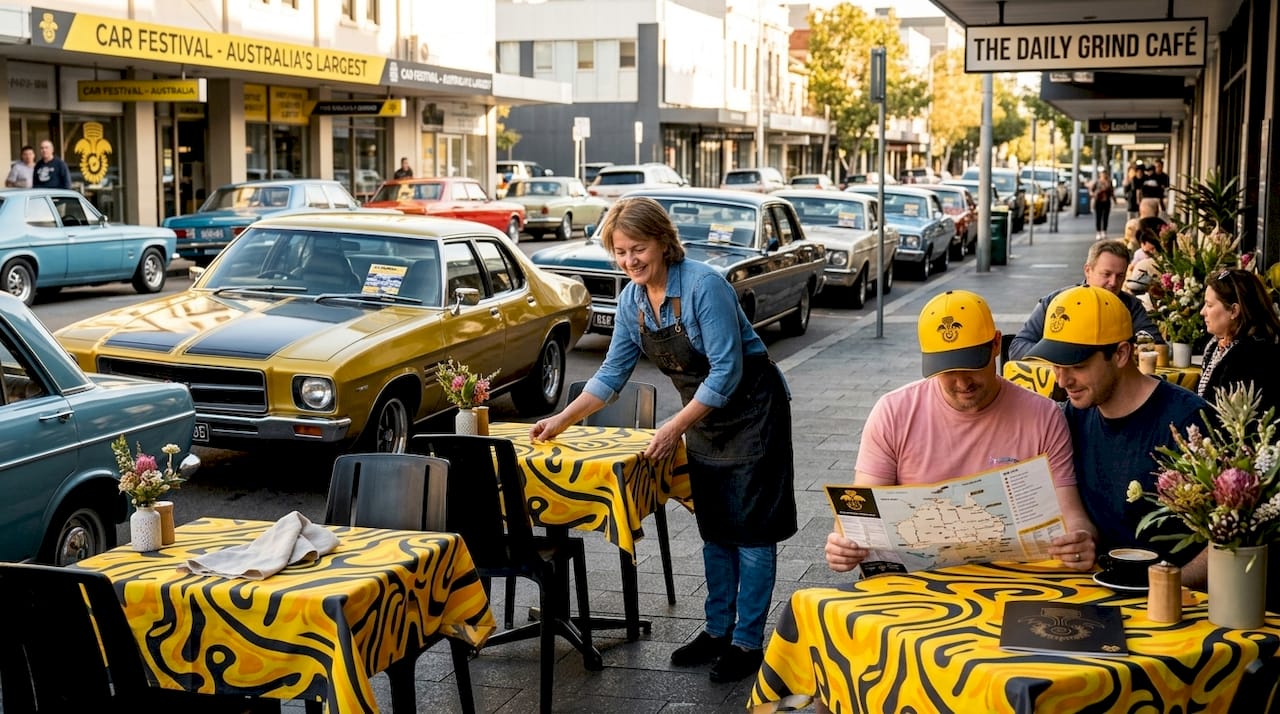
Events tied to local city districts generate significant economic and social effects, including direct integration into retail and hospitality precincts and strong correlations with visitor spending and repeat guests. A single well-run automotive lifestyle event can be among the highest-revenue days of the year for nearby restaurants, cafés, and small retailers.
Impact area | Typical outcome |
Local business revenue | Significant spike on event day, often the biggest of the season |
Visitor spending | Attendees travel regionally and spend on accommodation, food, and fuel |
Return visits | Many attendees become regular patrons of host-district businesses |
City district activation | Underused precincts gain foot traffic and media attention |
Social cohesion | Residents and enthusiasts interact, reducing community division |
Youth engagement | Younger participants connect with mentors and discover pathways in automotive trades |
The economic dimension matters for enthusiasts too, not just local councils. When events are known to benefit the community, they attract better venues, more support from local government, and improved infrastructure for future gatherings. It becomes a cycle of positive reinforcement.
The social outcomes are equally compelling. When people gather around a shared passion in a physical space, they form the kind of loose but genuine social bonds that researchers link to improved wellbeing. These are not deep friendships built overnight, but they are real connections with neighbours and strangers that digital communities struggle to replicate at the same depth.
Key economic and social outcomes to note:
Increased foot traffic to host-area businesses on event days
Stronger local identity and civic pride in precincts that host recurring events
Media coverage that amplifies tourism appeal beyond the immediate event audience
Networking between enthusiasts that leads to business relationships and job opportunities
Reduction in antisocial vehicle behaviour, as formal community events provide a constructive alternative
Want to see how boosting local engagement through well-organised events works in practice? The principles apply across both automotive and water sports communities.
How to spot (or host) an authentic lifestyle event
After covering impacts, it is time for practical application. Whether you are attending for the first time or considering launching your own gathering, there are clear signals that separate a genuine lifestyle event from a standard show or contest.
Use this checklist when evaluating or planning an event. Look for explicit language about people and community, learning and engineering discipline, and formats that enable real interaction rather than passive spectating. These three markers are the clearest indicators of genuine lifestyle focus.
Community language in promotion. Does the event description talk about people, connection, and shared stories? Or does it lead with horsepower figures and award categories?
Welcoming format for newcomers. Are there guided introductions, open layouts, or designated hosts who help first-timers feel included?
Interaction-enabling layout. Are vehicles displayed in a way that encourages conversation around them, or are they roped off behind barriers?
No rigid judging hierarchy. Does the event celebrate participation broadly, or funnel all attention toward a narrow winner?
Storytelling elements. Are there owner talks, marque histories, build diaries, or any format that puts the human story front and centre?
Signs of ongoing community. Is there a regular calendar, a returning crowd, or a platform where participants stay in touch between events?
Inclusive vehicle diversity. Does the event welcome a range of builds, eras, and styles, or is entry restricted to a narrow category?
Genuine hospitality. Is there food, comfortable gathering space, and a relaxed pace that encourages lingering?
Pro Tip: If you are organising an event for the first time, start small and prioritise atmosphere over scale. A gathering of 30 people who stay for three hours and leave with new connections outperforms a 300-car show where everyone moves through in 45 minutes without speaking to anyone. Depth of engagement is the real measure of success.
For a thorough walkthrough of the logistics behind organising social events within automotive and water sports communities, there is a dedicated guide that covers everything from venue selection to post-event follow-up.
Why automotive lifestyle events matter more than ever
Here is an opinion that may challenge conventional thinking in the enthusiast world: the car or the watercraft is almost incidental.
That is not to dismiss the engineering passion or the hours of work poured into a build. Those things are real and worthy of respect. But the reason lifestyle events continue to grow while purely competitive formats often plateau is that people are hungry for something that algorithms cannot serve them. They want to be seen, heard, and connected in the physical world by people who share their values.
We are living through a period of extraordinary digital saturation. Enthusiast forums, social feeds, and video channels offer extraordinary access to automotive and water sports content. Yet many people feel more isolated within their hobbies, not less, because passive consumption is not the same as belonging.
Lifestyle events are the antidote. They offer repeated face-to-face contact, shared norms, mentorship, and the kind of trust that builds slowly over seasons of attendance. These are the ingredients that automotive social networks and digital tools can support, but cannot replace on their own.
What most commentary overlooks is the role of memory. People do not return to events because the cars were impressive. They return because they remember how they felt: welcomed, stimulated, part of something genuine. The vehicles are the catalyst, but the relationships and memories are what sustain the community across years and decades.
The cultural, economic, and human connection value of these events is arguably more important now than at any previous point in the hobby’s history. As urban density increases and third places (those informal community spaces that are neither home nor work) disappear from many cities, events that create genuine gathering around shared passion fill a real social need. Enthusiasts who understand this are not just hobbyists. They are community builders.
Connect and create your own impact
Understanding the depth and value of automotive lifestyle events is just the beginning. The next step is getting involved, whether that means attending your first cruise night, joining a local watercraft meetup, or planning a gathering for your own crew.
AutoSocial is built for exactly this kind of participation. The platform brings together automotive and water sports enthusiasts across Australia in one dedicated space, making it straightforward to find upcoming events, connect with local communities, and organise your own gatherings. From public cruise nights to mystery events and private group chats, the tools are designed to support the kind of authentic, ongoing community that lifestyle events depend on. If you are ready to move from spectator to participant or organiser, the guide on how to organise a social event is a practical next step.
Frequently asked questions
What makes an automotive lifestyle event different from a typical car show or race?
Lifestyle events put the emphasis on community, shared experience, and story-sharing rather than trophies or competition. Automotive lifestyle events emphasise people and community, not just performance or display.
How do these events benefit local communities?
They boost local economies through increased visitor spending and help create vibrant, connected city spaces. Events can be the biggest revenue days of the year for local businesses and encourage repeat visits.
Can anyone organise or join an automotive lifestyle event?
Yes, enthusiasts of all backgrounds are welcome, and many modern events focus on inclusivity and mentorship. Many organisers prioritise inclusivity and authentic connections over exclusivity or strict competition.
Are water-sports lifestyle events similar to automotive gatherings?
Both prioritise community, repeated social contact, and cultural norms around passion for the hobby. For automotive and water-sports enthusiasts alike, lifestyle events function as genuine community organisers.
How do I recognise a true lifestyle event as a newcomer?
Look for group activities, story-telling, open interaction, and a clear focus on people rather than competition. Events with explicit language about people, community, and interaction signal genuine lifestyle focus.
Recommended


Comments