.png)


Understand every automotive event type: A complete guide

TL;DR:
Many automotive and watercraft events prioritize community, self-expression, and shared passion over competition or speed. Car meets and cruise-ins foster relaxed socialising, while motorsport events such as track days and jet sprint racing offer thrilling performance experiences. Combining different event styles enhances engagement, building stronger communities and enriching participants’ appreciation for machines and teamwork.
Most people assume that car events and watercraft gatherings are all about speed, competition, and who crosses the finish line first. That assumption misses the bigger picture. The automotive and water sports world is packed with event types that prioritise community, self-expression, and shared passion just as much as raw performance. Whether you are a seasoned car enthusiast or someone who has only ever watched from the sidelines, understanding the full range of event formats will help you find your place in the community and get far more out of every outing.
Table of Contents
Key Takeaways
Point | Details |
Events aren’t all about racing | Many automotive and watercraft events prioritise socialising, displays, and community over competition. |
Understand event types | Knowing the difference between meets, cruises, regattas, and races helps you pick the right event to join. |
Specialised formats exist | Unique event types like jetsprint offer high-adrenaline experiences beyond traditional gatherings. |
Blending styles expands fun | Combining community activities with competition draws in more enthusiasts and keeps events exciting. |
Car meets, cruise-ins, and community-focused gatherings
Now that you understand there is more to automotive events than just racing, let us break down the social formats that thrive on community spirit.
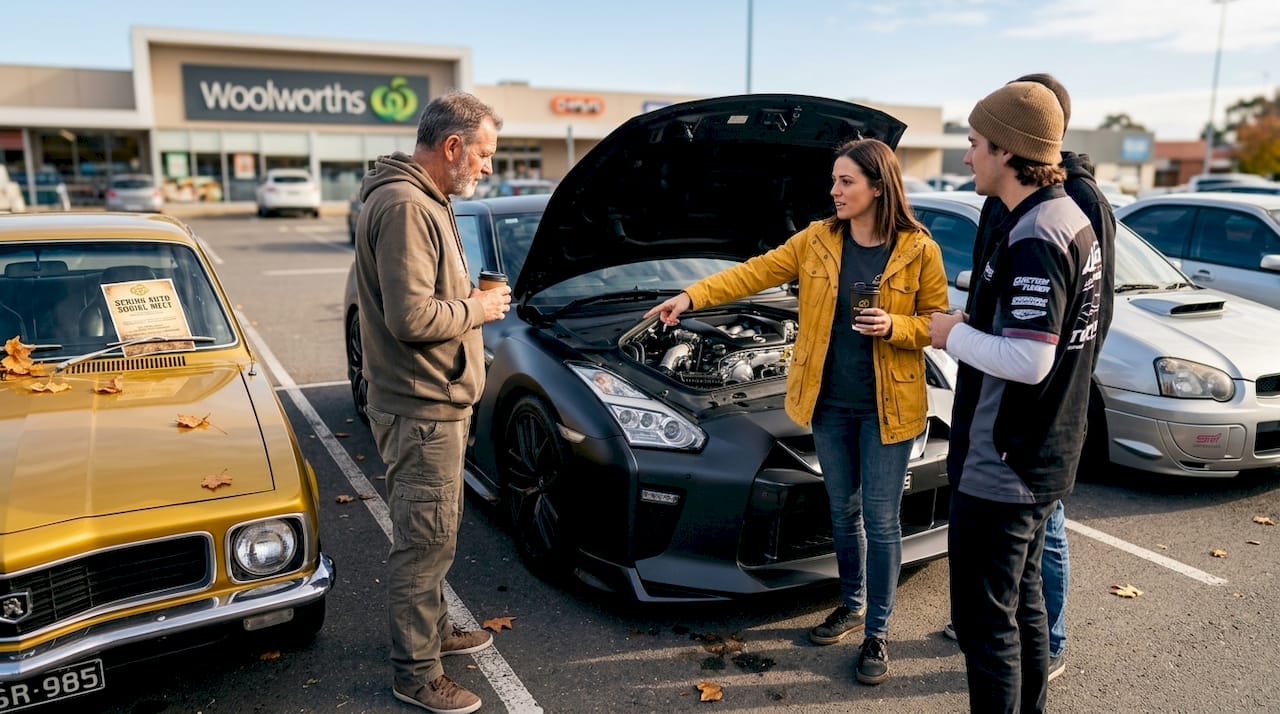
The car meet is the beating heart of grassroots automotive culture. At its core, a car meet is a relaxed gathering where owners bring their vehicles to a shared location, often a car park, showground, or waterfront area, to display them, chat with fellow enthusiasts, and enjoy the atmosphere. There is no podium. There is no qualifying lap. The whole point is connection.
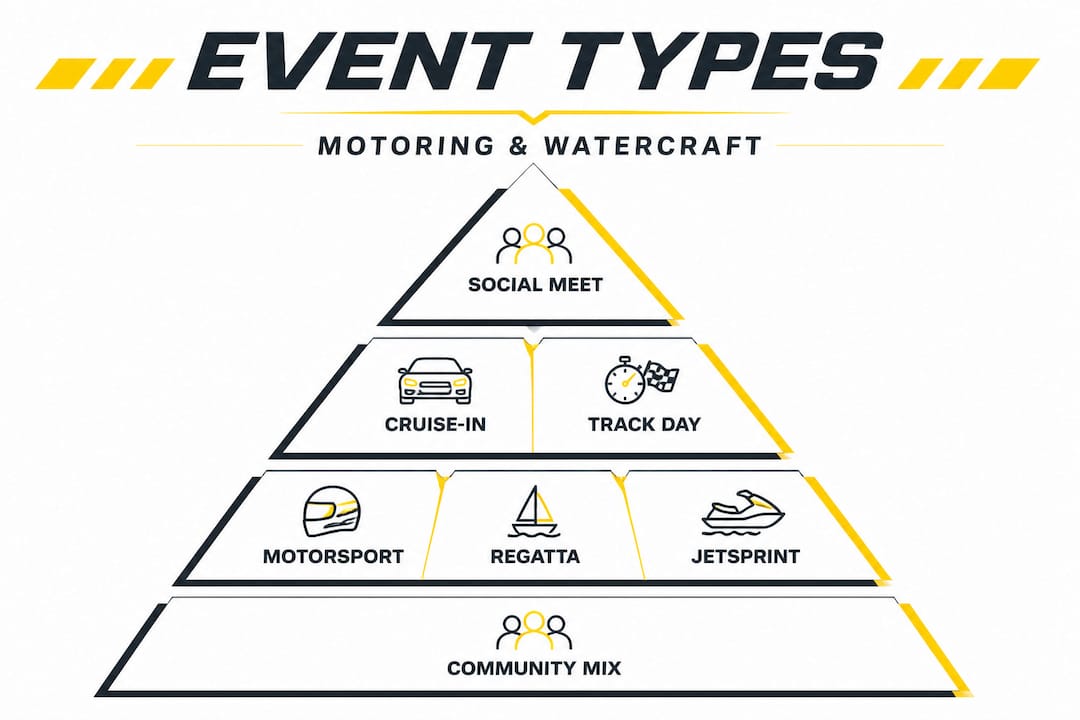
Cruise-ins take things a step further by adding movement to the mix. Participants drive a set route, often through a town or coastal road, before gathering at a final destination. Cruise-ins are display and roaming events centred on community rather than head-to-head racing. Events like Cruisin’ the Coast in the United States have shown just how powerful this format can be, drawing hundreds of thousands of participants across multi-day routes. In Australia, similar cruise-style gatherings happen regularly along iconic stretches of road from the Gold Coast hinterland to South Australia’s Fleurieu Peninsula.
Understanding the differences from motor gatherings focused on competition is essential here. Social car events are display-oriented, not performance-oriented. Judges, lap times, and prize money are largely absent. Instead, you get:
Swap meets where parts, merchandise, and memorabilia change hands
Entertainment zones with live music, food trucks, and family activities
Display classes grouped by era, make, or modification style
People’s choice voting where attendees themselves pick their favourites
Charity tie-ins that raise money for local causes while showcasing vehicles
The social side of these events is genuinely underrated. Many long-term friendships in the automotive world began at a cruise-in parking lot at 7am on a Sunday. Learning to organise social events well means understanding that atmosphere and accessibility matter just as much as the quality of the cars on display.
“The best car meets are the ones where you forget to take photos because you are too busy talking to people.” This kind of organic connection is what separates a great social event from a forgettable one.
Pro Tip: If you are attending your first car meet, arrive early. The best conversations happen before the crowds build, and the lighting for photos is usually better in the first hour.
Connecting with others through automotive social networks before an event helps you know who to look for on the day and makes the whole experience feel less intimidating if you are new.
Event type | Main focus | Competition? | Typical atmosphere |
Car meet | Display and socialising | No | Relaxed, welcoming |
Cruise-in | Scenic drive and display | No | Festive, community-driven |
Swap meet | Parts and merchandise trade | No | Busy, enthusiast-heavy |
Show and shine | Vehicle presentation judging | Yes (judged) | Polished, detail-focused |
Motorsport events: From track days to head-to-head competitions
Having looked at community-driven meets, let us shift gears to explore the thrill of motorsport events and how their structure contrasts with social gatherings.
Motorsport events exist on a broad spectrum. At one end you have casual track days where anyone with a roadworthy vehicle and a helmet can experience a circuit at speed. At the other end you have sanctioned competitions with licensing requirements, technical inspections, and championship points. Knowing where you sit on that spectrum makes it much easier to choose the right entry point.
Key motorsport formats include:
Track days (also called circuit days): Open sessions where participants drive their own vehicles on a closed circuit. No racing against others. The focus is on personal improvement, learning the track, and enjoying your car in a safe environment.
Time trials: Individually timed laps where the fastest time wins. Participants go out one at a time or in small groups, and results are ranked on the clock rather than wheel-to-wheel racing.
Drag racing: Straight-line acceleration events over a quarter-mile or eighth-mile strip. Head-to-head competition with bracket racing formats that allow vehicles of different performance levels to compete fairly.
Hill climbs: Timed runs up a defined hill course. One of the oldest motorsport formats in the world and still enormously popular in regional Australia.
Circuit racing: Full wheel-to-wheel racing on a closed circuit with a grid start. This is the format most people picture when they think of motorsport.
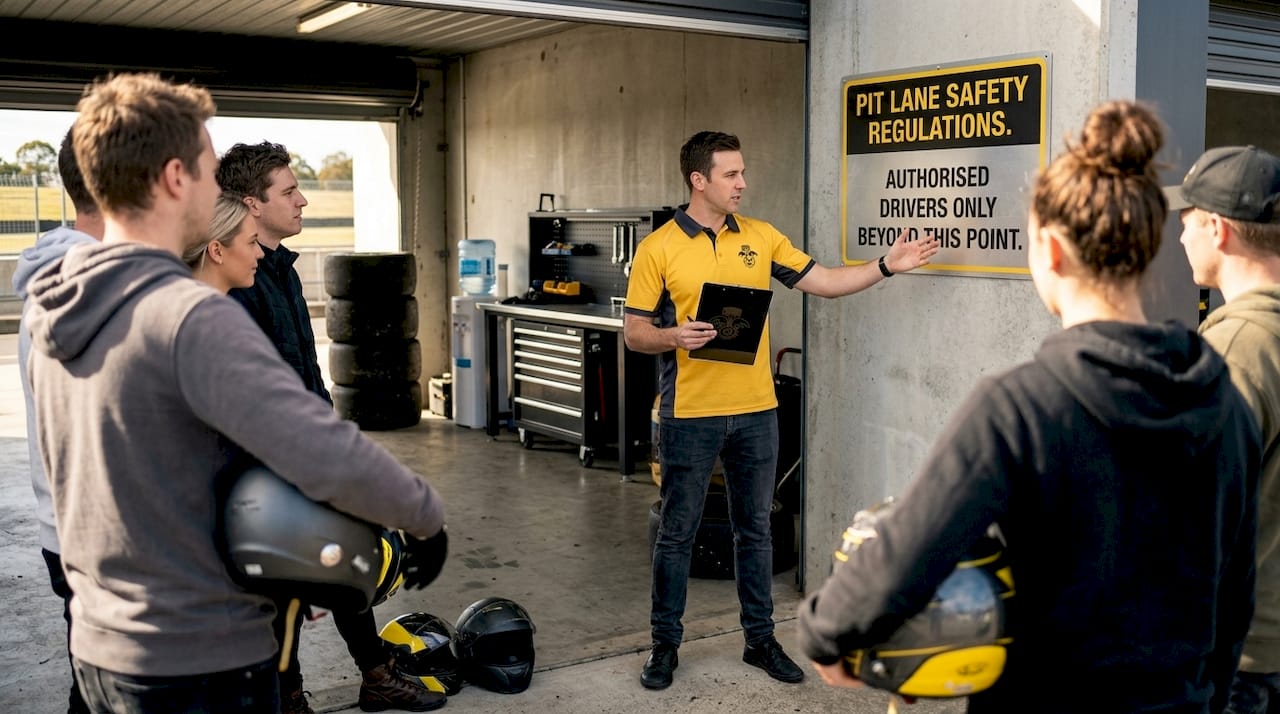
Understanding motor event differences between a casual track day and a sanctioned circuit race is critical before you sign up. Track days typically require minimal paperwork, while competitive events require a licence from your state motorsport authority, medical clearance, and vehicle compliance checks.
Important: Over 60% of first-time track day participants report that attending a structured briefing before their session significantly improved their confidence and safety awareness on circuit.
If you want to learn how to promote automotive events to attract the right crowd, understanding which format you are running is the first step. A track day needs a different promotional approach to a drag racing meet.
Steps to attending your first motorsport event:
Choose your format based on your vehicle, skill level, and goals
Check the specific requirements for that event (licence, helmet rating, fire extinguisher)
Book early as popular track days sell out weeks in advance
Attend the mandatory driver briefing without exception
Start conservatively and build pace gradually across the day
Debrief with more experienced drivers afterwards to accelerate your learning
Motorsport format | Skill requirement | Vehicle prep needed | Competition? |
Track day | Beginner friendly | Minimal | No |
Time trial | Intermediate | Moderate | Yes (timed) |
Drag racing | Beginner to advanced | Moderate to high | Yes (direct) |
Circuit racing | Licensed required | Significant | Yes (wheel-to-wheel) |
Hill climb | Intermediate | Moderate | Yes (timed) |
Safety culture in motorsport has improved dramatically over the past two decades. Most clubs run detailed inductions and place experienced marshals at every corner. The community spirit at track days is also surprisingly strong, with seasoned competitors often helping newcomers learn the craft.
Boat gatherings, regattas, and watercraft competition explained
While motorsport events bring speed and competition, watercraft gatherings offer their own unique blend of camaraderie and adventure.
The water-based events world is every bit as diverse as its automotive counterpart. Understanding the terminology makes it much easier to find the right event. A flotilla is essentially a car cruise on water: a group of boats travelling a shared route together, often with a social gathering at the end. These are social events focused on the joy of being on the water as a group, and they welcome almost anyone with a seaworthy vessel.
A regatta, on the other hand, has a more structured meaning. Regattas span racing and social formats, with the term traditionally referring to a series of boat or sailing races. However, many modern regattas include display classes, social programmes, and on-shore entertainment alongside the racing component. Participation does not always mean racing. Spectating, volunteering, and entering non-competitive display classes are all legitimate ways to get involved.
Other key watercraft event formats include:
Powerboat rallies: Organised runs along a coastal or river route, with checkpoints and social stops. Emphasis is on participation and shared experience.
Jet ski meetups: Informal or organised gatherings of personal watercraft riders, often at a popular bay or beach access point. These are growing rapidly in popularity across coastal Australia.
Wakeboard and watersports festivals: Multi-discipline events combining towed watersports, personal watercraft, and boat displays.
Offshore powerboat racing: High-speed competition over open water courses, requiring specialised vessels and significant safety infrastructure.
Pro Tip: If you are attending a watercraft event for the first time, check the noise and wash restrictions for the venue in advance. Many popular waterways have speed and wake limits that apply even during events, and understanding these rules saves you from an awkward encounter with water police.
Getting started with how to organise water sport events effectively means knowing which format suits your waterway, your group size, and your participants’ experience levels.
Practical challenges for watercraft event newcomers include understanding maritime rules of the road, ensuring your vessel’s safety equipment is current, and knowing how to communicate on the water with other participants. Most clubs and event organisers offer orientation sessions that cover all of this in a welcoming, non-intimidating way.
What is jetsprint? The wild world of jet-boat time attack
For those curious about the most technical and visually impressive water racing, jetsprint offers a unique experience.
Jetsprint is arguably the most exciting spectator sport on Australian waterways. It is raw, fast, and deeply technical. Jetsprint uses two-person crews racing individually against the clock through a twisting channel course in shallow water that is less than a metre deep. The course is marked by gates, and the navigator calls out which gate to hit next while the driver reacts in real time. There is no predetermined memorised course. The whole run unfolds at speeds up to 135 kilometres per hour in water barely deep enough to float the boat.
“In jetsprint, the driver has no idea which gate is next. That is the job of the navigator, who reads the course card and calls every turn at race speed. The whole team’s result depends entirely on how well two people communicate under extreme pressure.”
This communication element is what makes jetsprint so different from other forms of boat racing. It is not purely about the fastest boat. It is about the fastest team.
A typical jetsprint event from the team’s perspective:
Scrutineering: Technical officials inspect the jetboat for safety compliance, including kill switches, hull integrity, and fire suppression systems
Practice runs: Teams take orientation passes to get a feel for the water conditions and course layout
Seeding runs: Initial timed runs that establish the starting order for finals
Head-to-head elimination or aggregate timing: Depending on the event format, teams either race in parallel or accumulate timed scores across multiple runs
Finals: The fastest teams compete for the overall result with the crowd packed close to the course banks
Award ceremony and social programme: Like all great Australian sporting events, it finishes with the community together
The safety requirements for jetsprint are significant. Helmets, fire-retardant race suits, neck braces, and full roll-over protection are mandatory. Jetboats are purpose-built with jet propulsion rather than propellers, which makes them uniquely suited to shallow-water racing and eliminates the prop-strike hazard present in other powerboat formats.
Jetsprint events are held across New Zealand and Australia, with venues ranging from purpose-built courses to natural river channels. As a spectator, you can get remarkably close to the action. That proximity to raw speed in a shallow waterway is something no other motorsport format quite replicates.
Why mixing event styles unlocks new experiences
Here is a perspective that does not get enough airtime in enthusiast circles: the most rewarding events are often not the ones that fit neatly into a single category.
Think about what happens when an automotive club combines a morning cruise with an afternoon track experience at a local circuit. The cruise builds energy and camaraderie. The track session gives people a safe context to push their vehicles. Each format makes the other better. Participants who would never have attended a track day alone feel comfortable doing it alongside their cruise-night crew.
The same dynamic plays out on the water. Flotilla organisers who add a friendly time-trial component to their gathering often find that engagement goes up sharply. People who came for the social element discover a competitive streak they did not know they had. People who came for the racing discover friendships that last beyond the event.
Connecting through automotive social networks is where this cross-pollination starts. When you follow enthusiasts across different disciplines, you naturally get invited to formats outside your usual comfort zone.
The conventional wisdom says to pick your niche and go deep. Our experience says the most engaged and fulfilled community members are the ones who occasionally step sideways. A car person who attends a jetsprint event as a spectator often walks away with a completely different appreciation for precision, teamwork, and speed. A watercraft enthusiast who shows up at a show-and-shine often finds the vehicle modification culture surprisingly familiar.
The communities are not as separate as the event types suggest. The common thread is passion for machines, movement, and the people who share that passion.
Easily find and join the right event for you
Ready to explore, join, or host an event? The right tools can make all the difference.
Finding the right automotive or watercraft event used to mean scrolling through dozens of Facebook groups, checking local club websites, and hoping you did not miss something posted in a forum thread from three years ago. There is a better way.
AutoSocial is built specifically for the communities covered in this guide. Whether you are hunting for a local car meet, a jetsprint event on the weekend, a jet ski meetup at your nearest bay, or a motorcycle cruise through the hills, AutoSocial brings it all into one place. You can create a themed profile, join private group chats, discover both public and mystery events, and even organise your own gathering with tools designed for enthusiasts. Stop piecing together information from scattered sources and start finding your community in one place.
Frequently asked questions
What is the main difference between a car meet and a car race event?
A car meet is focused on socialising and displaying vehicles, while a car race event centres on competition and speed. Cruise-ins are community events built around display and roaming routes, not head-to-head racing.
What does the term ‘regatta’ mean in boating?
A regatta refers to a series of boat races, often combined with social or promotional activities on shore. Regattas span racing and social formats, covering everything from sailed races to powerboat competition series.
How is jetsprint different from other boat racing events?
Jetsprint involves timed individual runs with two-person jetboat crews navigating a narrow, shallow course at speed, focusing on precision and team communication rather than direct side-by-side racing. Two-person crews race against the clock through a twisting channel in less than a metre of water.
Can I join a car or watercraft event as a beginner?
Yes, many events across both automotive and watercraft communities are specifically designed to welcome newcomers and focus on community participation as much as any competitive element. Social formats like car meets, cruise-ins, and flotillas have no prerequisites beyond showing up with enthusiasm.
Recommended


Comments