.png)


Essential tips for organising car and water sports events


TL;DR:
Effective planning, budgeting, permits, safety, and weather strategies are essential for successful events.
Building community engagement before, during, and after the event ensures long-term participation.
Using technology and rehearsing plans minimizes chaos and adapts smoothly to unforeseen challenges.
Pulling off a memorable car meet or water sports event takes far more than booking a venue and spreading the word. Organisers face a tangle of logistics, shifting regulations, unpredictable weather, and the constant pressure to deliver an experience that keeps the community coming back. Whether you are planning a local cruise night at the foreshore or a full-scale jetski competition on open water, the gap between a good event and a great one comes down to preparation, adaptability, and genuine connection with your community. This guide gives you the practical frameworks and expert-backed strategies to make your 2026 events stand out.
Table of Contents
Key Takeaways
Point | Details |
Plan well in advance | Set early timelines and reserve a contingency budget for any event size. |
Prioritise permits and safety | Treat permits and safety assets as non-negotiable, starting these processes first. |
Prepare for uncertainty | Rely on multiple weather sources, clear thresholds, and rehearsed communications for resilience. |
Leverage tech and routines | Use live-streaming and consistent on-site flow for smooth experiences. |
Engage your community | Regular updates, involvement, and transparent follow-up build lasting event loyalty. |
Establish timelines and budget allocations early
After framing the overall challenge, focus on the bedrock of all successful events: effective timelines and airtight budgeting. Getting these right from the start prevents the scramble that derails so many well-intentioned gatherings.
Major events should begin planning 12 months in advance, with local events requiring at least 6 months out and a 20 to 25% contingency line built into every budget. That contingency is not just a safety net. It is an active planning tool that absorbs cost overruns on generator hire, last-minute signage, or a permit that takes longer than expected to approve.
“Treat your contingency budget like fuel in the tank. You might not need all of it, but running out mid-event is not an option.”
Here is a clear snapshot of recommended planning windows based on event scale:
Event type | Planning lead time | Contingency budget |
Major regional event | 12 months | 25% |
Mid-size community event | 9 months | 20% |
Local meetup or cruise night | 6 months | 15% |
Pop-up micro-event | 4 to 6 weeks | 10 to 15% |
Beyond the numbers, organising your timeline into checkpoints keeps the whole crew accountable. Key milestones to lock in early include:
Permits and council approvals confirmed at the 10 to 12 month mark for large events
Venue and supplier contracts signed no later than 8 months out
Marketing and promotion launch starting at 6 months, ramping up closer to the date
Volunteer and staff rosters finalised at least 6 weeks before the event
Expense tracking initiated from day one, not just from when major costs hit
Transparency matters. When every dollar is logged from the start, it is far easier to identify where savings are possible and where you need to allocate more. Learning how to promote automotive events effectively also requires budget planning well before the event goes live, because late promotion rarely moves the needle.
Using event calendars for community planning keeps your stakeholders aligned and gives attendees confidence that your event is professionally run. A visible calendar signals credibility and builds anticipation.
Pro Tip: Break your budget into three tiers: confirmed costs, likely costs, and speculative costs. Revisit each tier monthly to keep your forecasting accurate.
Master permits, insurance, and safety protocols
With timelines and budgets clarified, next tackle the non-negotiables: permits and safety, which can make or break your event.
Many organisers treat permitting as a box-ticking exercise and pay the price when councils reject applications or request additional documentation at the worst possible time. Permitting should be treated as a dedicated project, including a one-page permit dossier that captures capacity, risk mitigations, key contacts, and emergency plans. For local beach or waterfront events, start the permitting process 6 to 8 weeks before your event at a minimum.
A well-prepared permit dossier typically includes:
Event name, date, location, and expected attendance
Risk assessment with identified hazards and mitigations
Emergency contact list and onsite safety officer details
Insurance certificate of currency
Site map showing access points, emergency exits, and first aid stations
Noise and environmental management notes where applicable
For water-based events, safety assets are non-negotiable. Lifeguards, a fully stocked first aid kit, and an AED (automated external defibrillator) must be staged for swim or water events without exception. These are not optional additions. They are the baseline expectation for any responsible organiser.
For automotive events, the safety requirements shift but remain equally important. Follow this numbered sequence for onsite safety preparation:
Map and clearly signpost all emergency vehicle access routes before any attendees arrive
Brief marshals and volunteers on emergency protocols at least one hour before gates open
Post visible fire extinguishers at fuel and generator points
Assign a designated safety officer with a direct line to event leadership
Conduct a final walkthrough of the site with your safety officer before opening
Securing appropriate public liability insurance is essential for both participant and organiser protection. Speak to a broker who specialises in events. Generic policies often have gaps for motorsport or watercraft activity. The step by step event planning process for car and water sports events covers these requirements in detail and is worth reviewing alongside your legal obligations.
Pro Tip: Keep a digital copy of all permits, insurance certificates, and emergency contacts on a shared cloud folder that every key staff member can access from their phone on the day.
Build robust weather and uncertainty plans
Once compliance and safety are squared away, shift to dynamic elements: weather risks and pivot plans.
Outdoor automotive and water sports events are especially exposed to weather disruption. A beautifully planned jetski race or hillclimb show can unravel quickly without a defined decision-making framework. The key is removing ambiguity before the pressure is on.
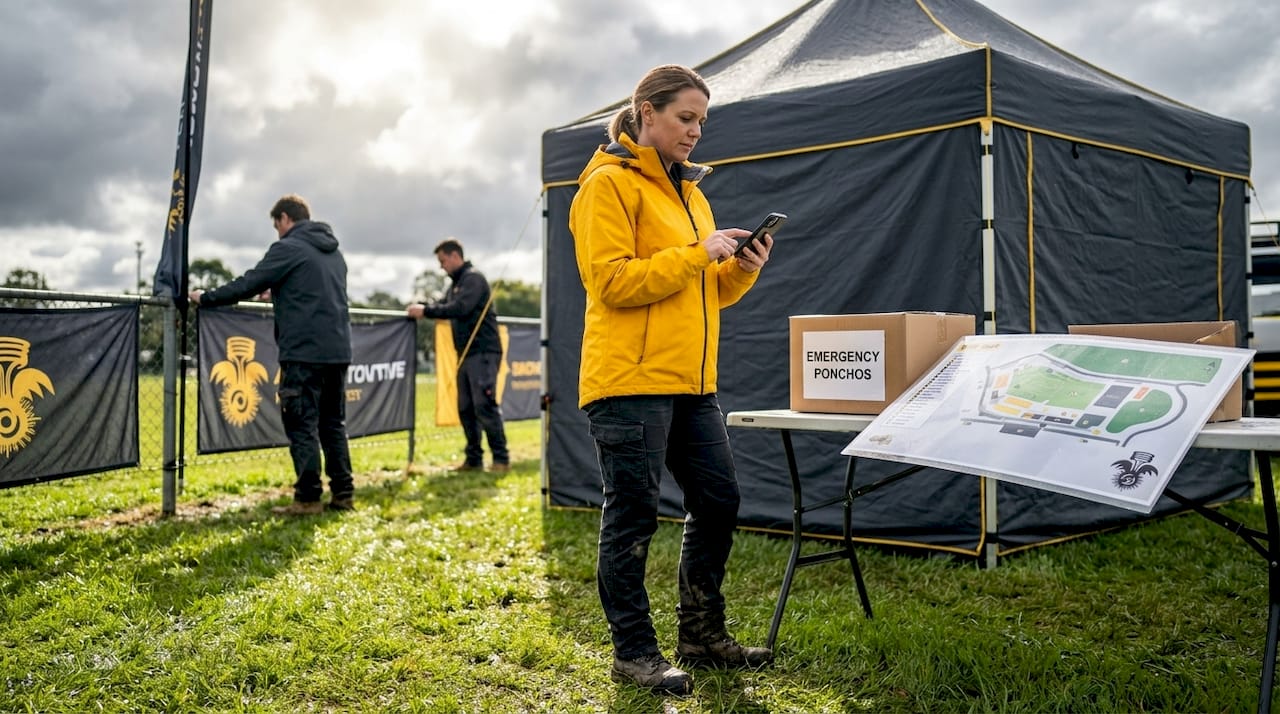
Use multiple weather sources, set explicit go/delay/cancel thresholds, and rehearse uncertainty workflows with your team well before event day. Two reliable weather sources recommended for Australian conditions include the Bureau of Meteorology and Windy.com, which gives granular wind and wave data ideal for watercraft events.
Here is a practical comparison of how different threshold approaches play out:
Approach | Strength | Risk |
Single source weather check | Simple and fast | Higher chance of inaccurate read |
Dual source with set thresholds | Consistent, defensible decisions | Requires pre-event calibration |
Real-time monitoring with assigned decision-maker | Responsive on the day | Depends on individual judgement |
Automated alerts with pre-agreed criteria | Removes emotion from decisions | Needs setup investment |
“Uncertainty is not a threat to good events. It is just another variable to plan for. The organisers who rehearse their pivot plans are the ones who handle the unexpected with confidence.”
Practical steps to build your weather and uncertainty plan include:
Define wind speed, rain, or wave height thresholds for each go/delay/cancel scenario specific to your event type
Draft communication templates in advance for email, social media, and group messaging platforms
Assign one person to be the weather monitor and decision communicator on event day
Allocate 10 to 15% of your contingency budget specifically for weather-related pivots such as marquee hire or venue change
Run a tabletop rehearsal with organisers and volunteers to role-play a weather cancellation scenario at least two weeks out
You can also share your organise social events learnings from each event to help your community understand how decisions get made. Transparency builds trust, and trust keeps attendance strong even when weather disruptions happen.
Streamline operations with on-site flow and tech
Having addressed risk reduction, focus now on efficient, guest-friendly event delivery through solid operational routines.
Technology adds enormous value to modern car and water sports events, but it can also become the biggest source of chaos if it fails under pressure. The fix is simple but often skipped: test everything early. Testing live stream setups at least 90 minutes before the event, building routine on-site rituals, and planning offline tech backups are the hallmarks of seasoned event management.
Here is a practical checklist for on-site tech and flow management:
AV and live stream check at least 90 minutes before start time, with a secondary device ready as backup
Registration and check-in systems tested the night before, with a paper-based fallback option prepared
Signage and wayfinding in place before any attendees or participants arrive on site
Volunteer briefing and role cards distributed so every person knows their station and escalation contact
Session flow mapped out with clear timings for welcome, activity, cooldown, and wrap-up segments
Designing a repeatable session rhythm matters more than most organisers realise. Short, coached activities followed by structured cooldowns and social time create a predictable cadence that participants genuinely enjoy. It also makes it far easier for volunteers to manage crowd movement and energy levels throughout the day.
Assign at least two staff members specifically to troubleshoot tech and people bottlenecks. One person cannot manage a streaming failure and a registration queue issue at the same time. Separation of roles prevents single points of failure.
If your event includes a hybrid or online component, the guide to virtual car meets offers solid grounding in making remote participation feel as engaging as being there in person. Pairing that with the right car event planning tools means your logistics stay organised no matter how complex the setup becomes.
Pro Tip: Create a laminated one-page “day of” operations guide for each volunteer role. It removes the need for constant radio check-ins and empowers your team to act confidently.
Keep community engagement at the centre
Finally, after systematising on-site execution, tie all efforts back to the heart of event success: vibrant, ongoing community engagement.
The best-organised event in the world falls flat if the people attending do not feel connected to it. Community engagement is not a marketing tactic. It is the reason the event exists. Getting this right means involving your community before, during, and after every gathering.
Start by pulling in community leaders and trusted voices early in the planning process. When people feel ownership over an event, they show up and bring others. Regular digital updates via community event calendars keep your broader audience informed and give potential attendees a reason to stay tuned.
During the event itself, build in structured time for connection:
Meet-and-greet sessions at the start to break the ice, especially for first-time attendees
Organised group activities that mix experience levels, such as guided cruise routes or group paddling sessions
Feedback stations where attendees can drop a comment card or scan a QR code to share their thoughts in real time
Networking windows between sessions rather than filling every minute with programme content
Recognition moments that celebrate participants, volunteers, and sponsors publicly during the event
The post-event window is equally important and too often neglected. Send a personalised thank you within 48 hours. Share photos, clips, or stream highlights on your community channels. Publish the results of any feedback survey and communicate what you will act on for the next event. This cycle of listening, acting, and reporting back builds the kind of community ownership that turns a one-off event into an annual fixture.
Our perspective: What most guides miss about event organising
Every event planning guide covers permits, budgets, and weather plans. But the reality of running car and water sports events reveals some less-discussed truths that are worth naming directly.
Most organisers underestimate the cumulative effect of small delays. A permit that takes two extra weeks, a supplier confirmation that drags on, and a marketing launch that slips by ten days can each seem manageable in isolation. Together, they compress your preparation window and force reactive decisions that cost more and deliver less. The fix is not working faster. It is building deliberate buffers into every checkpoint from the start.
There is also a pattern worth highlighting around communication scripts. When something goes wrong on event day, whether it is a weather cancellation or a tech failure, the organisers who handle it well are almost always the ones who prepared their messaging in advance. They do not scramble for words under pressure. They execute a plan. The organisers who struggle are the ones who assumed they would “figure it out on the day.” That assumption is what separates a smooth pivot from a reputational misstep.
Another underappreciated error is budgeting only for what is visible. Visible costs are easy: venue hire, catering, equipment. Invisible costs are harder: the hours spent on permit revisions, the fuel for extra supply runs, the replacement gear bought at retail because the original order did not arrive. These are the costs that blow budgets consistently. Building a genuine ambiguity allowance alongside your contingency line is a practice that marks truly experienced organisers.
Understanding what makes car events stand out from generic gatherings is also worth studying. The difference often comes down to authentic atmosphere and intentional design, not the size of the budget.
Finally, rehearsal is not just for the big elements. Rehearse the registration flow. Walk the volunteer through their first fifteen minutes. Simulate a weather delay call with your communications lead. The more you debug your plan before show day, the fewer surprises you face when it matters most.
Take your next event further with AutoSocial
Bringing all these moving parts together is exactly what AutoSocial was built for. Whether you are organising a beachside jetski meetup or a multi-stage car cruise, having the right platform behind you makes the difference between a scattered effort and a polished, well-attended event.
AutoSocial gives automotive and water sports organisers a purpose-built space to plan events, manage timelines, communicate with their community, and build the kind of belonging that keeps people coming back. From private group chats to public event listings and mystery event formats that generate genuine buzz, AutoSocial consolidates what used to require five different tools into one community-first platform. If you are ready to stop managing events through scattered Facebook groups and forums, it is time to explore what AutoSocial can do for your next event.
Frequently asked questions
How early should I start planning a car or water sports event?
Begin planning major events 12 months out and local events at least 6 months ahead to allow time for permits, supplier contracts, and community promotion.
What is a permit dossier and why does it matter?
A permit dossier is a one-page summary of capacity, risk mitigations, and contacts that speeds up council approvals and demonstrates your event is professionally managed.
How can I manage unexpected weather at outdoor events?
Set go/delay/cancel thresholds based on wind speed or rainfall, monitor two weather sources, and rehearse your contingency communication plan with your team before the event.
What safety assets are needed for water sports events?
You must stage lifeguards, first aid kits, and an AED on site for any swim or water sports gathering to meet minimum safety standards.
How do I keep my event community engaged post-event?
Send a thank you message within 48 hours, share event highlights and photos across community channels, and publish feedback results to show attendees their input shapes what comes next.
Recommended


Comments